Binge drinking
Alcohol is the most widely used recreational drug in Australia. We have a culture of socially accepting the drinking of alcohol, with many Australians drinking after work, at barbeques, on the weekend, and at sporting events - just to name a few.
What is binge drinking?
Binge drinking is drinking heavily on a single occasion, or drinking continuously over a number of days or weeks. It is also commonly known as 'getting smashed', or 'drinking to get drunk' (1).
A person who binge drinks may usually have restrained drinking habits, but may frequently overindulge to an extreme level.
Alternatively, someone may not necessarily set out to drink a lot, but may be unsure of their limits, resulting in drinking too much over a short period of time.
You may also be more likely to binge drink if you are feeling peer pressure to do so. Or, you may be feeling anxious or socially awkward, for example at a party, and you may binge drink with the aim to reduce those feelings.
Is binge drinking harmful?
Binge drinking can be immediately and directly harmful to your health. It can expose you to injury or to unnecessary risks to yourself and others.
As well as having adverse short-term effects, binge drinking can also cause long-term effects on your health and well-being.
Short term effects of binge drinking
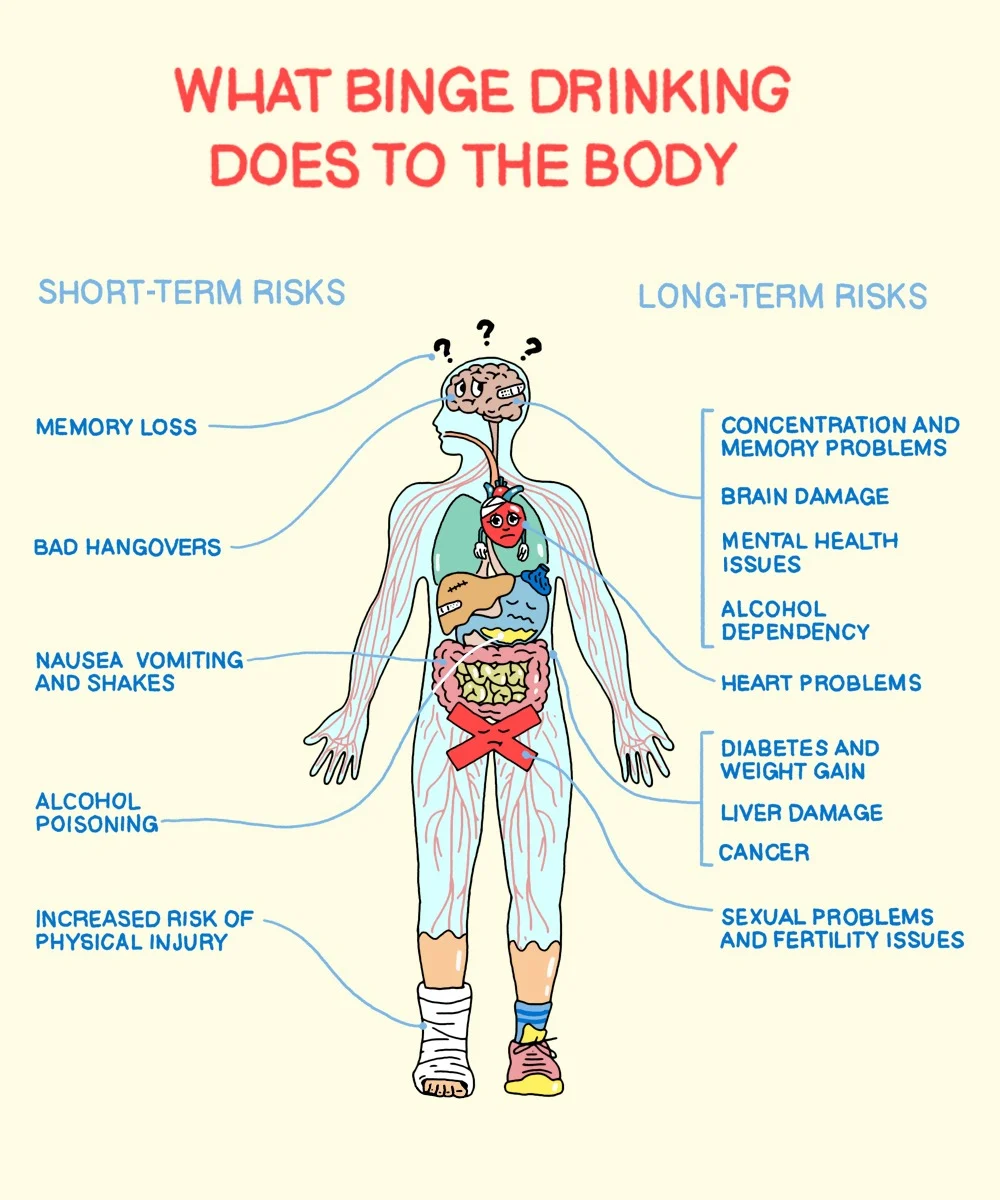
If you drink to excess you're likely to experience a number of physical effects, including:
- hangovers
- nausea
- shakiness
- vomiting and memory loss
- injury to yourself
- alcohol poisoning.
Alcohol is a major cause of injury and death among young people. When you’re drunk, you’re more likely to put yourself in risky situations, like getting into a car with someone who’s been drinking, or being the perpetrator or victim of violence.
Some facts about alcohol:
- On average, one in four hospitalisations of 15 -25 year olds happen because of alcohol (2)
- 70 Australians aged under 25 will be hospitalised due to alcohol-caused assault in an average week
- Four Australians aged under 25 die due to alcohol related injuries in an average week (3).
Long-term effects of binge drinking regularly
Continuous heavy drinking over a long period of time can lead to:
- physical and psychological dependence on alcohol
- significant damage to the brain and liver
- risk of cancer of the mouth, throat or oesophagus
- possible increased risk of neurological disorders, heart problems, and sexual problems (especially male impotency)
- risk of emotional and mental health problems developing, such as depression and anxiety
- problems at school, work and with relationships.
Other possible effects of binge drinking
In addition to the health risks, binge drinking may also impact your self esteem and social life, because you may find yourself doing things when you’re drunk that you wouldn’t normally do if you were sober. In fact, one in two Australians aged 15 – 17 who get drunk will do something they regret.
Being drunk affects your judgement and may lead to you:
- Having unprotected sex, or unwanted sex. This might lead to unwanted pregnancy, or STIs.
- Feeling bad about yourself and embarrassed by your actions
- Losing friends or loved ones as a result of your behaviour
- Losing money that you need for other things after reckless spending on alcohol
What is a standard drink?
The amount of alcohol you drink is often stated in terms of 'standard drinks'. In Australia a standard drink is any drink that contains 10 grams of pure alcohol, but it is obviously difficult to know how much this is just by looking at a glass!
Knowing how many standard drinks you are having may help you in managing your alcohol use. Different types of alcoholic drinks contain different amounts of pure alcohol.
For a helpful guide that shows how many standard drinks are in a variety of common alcoholic beverages, visit the NHMRC website.
It may be helpful to remember that alcohol is not always served as standard drinks.
For more information about standard drinks check out the DrugInfo Clearinghouse (ADF) fact sheet on alcohol.
How much can you drink?
We all respond to alcohol differently, and it is important that you know your own limits, and understand how alcohol affects you as an individual.
How alcohol affects you may be influenced by a number of factors, such as:
- how much alcohol you drink
- how quickly you drink it
- whether you consume the alcohol with other drugs
- whether you're male or female
- your mood
- your body type
- whether or not you've eaten.
If you have not drunken alcohol before, it may be difficult for you to know what your limits are. The first time you drink alcohol, it may be a good idea to try drinking in a safe area, where someone can help you if you drink too much. This might be at home, or at a friends place.
Australian guidelines to reduce health risks from drinking alcohol
In 2009, the National Health adn Medical Research Council (NHMRC) published the Australian Guidelines to Reduce Health Risks from Drinking Alcohol.
The Guidelines are based on extensive research and are set out below.
Guideline 1 - Reducing the risk of alcohol-related harm over a lifetime
The lifetime risk of harm from drinking alcohol increases with the amount consumed.
For healthy men and women, drinking no more than two standard drinks on any day reduces the lifetime risk of harm from alcohol-related disease or injury.
Guideline 2 - Reducing the risk of injury on a single occasion of drinking
On a single occasion of drinking, the risk of alcohol-related injury increases with the amount consumed.
For healthy men and women, drinking no more than four standard drinks on a single occasion reduces the risk of alcohol-related injury arising from that occasion.
Guideline 3 - Children and young people under 18 years of age
For children and young people under 18 years of age, not drinking alcohol is the safest option.
a) Children under 15 years of age are at the greatest risk of harm from drinking and that for this age group, not drinking alcohol is especially important.
b) For young people aged 15−17 years, the safest option is to delay the initiation of drinking for as long as possible.
The reason for this is that alcohol can affect brain development and lead to alcohol-related
problems in later life.
Guideline 4 - If you're pregnant or breastfeeding
Maternal alcohol consumption can harm the developing fetus or breastfeeding baby.
a) For women who are pregnant or planning a pregnancy, not drinking is the safest option.
b) For women who are breastfeeding, not drinking is the safest option.
Check out the guidelines for more detailed info.
Tips for controlling your drinking
There are a number of things you can do to keep your drinking under control, including:
- set limits for yourself and stick to them
- start with a non-alcoholic drink
- try having a 'spacer' - alternating non-alcoholic drinks with alcoholic drinks
- drink slowly - take sips not gulps
- try a low alcohol alternative to a pre-mixed drink
- eat before or while you are drinking, avoid salty snacks, they make you thirsty
- avoid rounds or 'shouts'
- have one drink at a time, so you can keep track
- avoid sculling competitions, and drinking games
- stay busy - don't just sit and drink
- be assertive - don't be pressured into drinking more than you want or intend to.
Managing alcohol intake
Managing your alcohol use may be difficult. If you reduce your alcohol use you may still crave for it for sometime afterwards. Try not to be too hard on yourself if you don't reach your immediate goal.
Having to try several times may be part of reducing your use and it is important you keep trying. It may be helpful to have someone you can talk to. This may be a friend, a family member, doctor or a counsellor.
Check out the Who can help you section of the site to find more about help available for you.
References
- DrugInfo Clearinghouse, ‘Binge Drinking’ Fact Sheet Number 1.10, revised June 2009,
- Chikritzhs, T. and Pascal, R. (2004). Trends in Youth Alcohol Consumption and Related Harms in Australian Jurisdictions, 1990–2002. Bulletin No. 6. National Drug Research Institute.
- National Drug Research Institute (2008). 2004-05 Hospitalisation and morbidity data for Australians aged 0 to 24. Unpublished raw data.
Email this page
Not a member?
Join Reach Out to access a range of great member features.
Forgot your password?
8 Comments
Log in to join the conversation. Join Reach Out.
nora
about 1 year ago
Reply Reportthis is really good info for my PDHPE assigment i like it :)
also it has given me info about alcohol that i didn't even know
Alphabet
12 months ago
Reply ReportThis is a really good info to have. Ive heard of binge drinking but now know there is so much more to it and how it can affect someone.
Those tips are awesome. I think the timing one is really true as i know with a lot of my friends they tend to drink a lot before they go out and in a hurry and early into the night they feel the affect of it.
I find it good to limit my money when i go out, so i can keep an eye on how much i drink so i dont drink too much.
tyronachieves
12 months ago
Reply ReportI have realised that i need a hobby or something to keep me off my drinking, but i cant find it... besides that can anyone give tips besides find something else to do because i have tried everything!
Alphabet
12 months ago
Reply ReportI wouldnt give up on trying to find a hobby or something to distract you when you feek like drinking, it may just take time to find something that can work.
Porcelain
4 months ago
Reply ReportI think I was forced spiritually really ((this is scary)) to not drink. I was invited to dinner w/ my co-workers & i was dying for drinks - when I drank the wine my God, the tabled turns & my migraine spun out of control and turned to my boss & said: Um - why is the table turning, migraines are killing me. I don't think I want a another drink and so another co-worker took my glass instead & shared it amongst one another.
Jodi3Bell
4 months ago
Reply ReportMy brother (21) is suffering from schizophrenia, Bipolar and Depression all because of alcohol and drugs. He was 16 when he was diagnosed with his illness, i was 7, i had no idea what his illness was until 2 years ago. i feel extremely guilty for saying things that may have put him down then. i am never doing Drugs or alcohol because i fear that this might happen to me......will it???
rosevillelad.
2 months ago
Reply ReportI find this information very useful in completing a PDH worksheet.
cheers :)
rosevillelad.
2 months ago
Reply Reportlalal. sah is a babe